
✶ Camas ✶
Haven Making II: The Wild Ones

✶ Camas ✶
Haven Making II: The Wild Ones
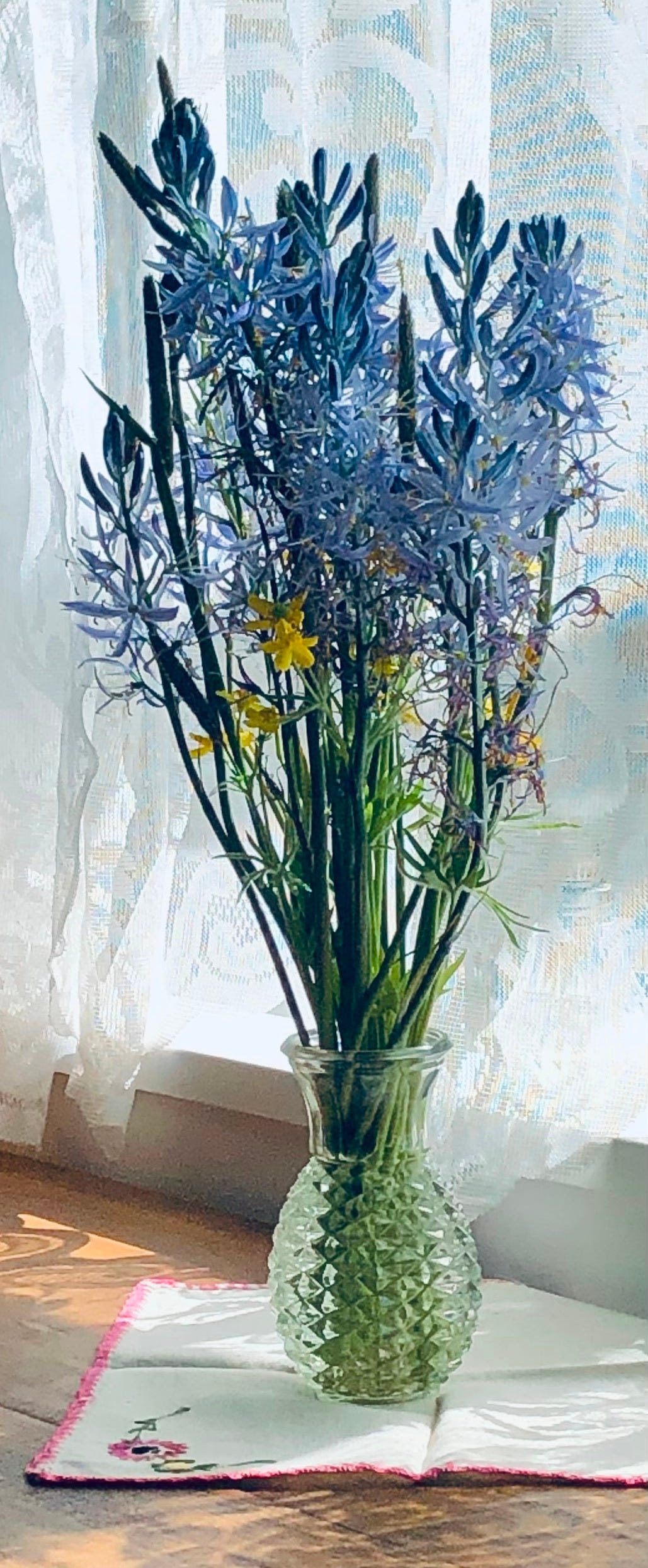
In the last letter, I shared I was participating in the Idaho Master Naturalists program. It is a volunteer/education program headed up by Idaho Fish & Game whereby you volunteer 40 hours on approved projects (such as counting raptors for a survey, making Cottonwood cuttings for habitat restoration, planting said trees when they’ve rooted, etc.); and 40 hours of education time with topics on weather, tracks, and ungulate migrations, for example. I really enjoyed the scat presentation (you can learn a whole heap of information if you’re paying attention to whose poo you are seeing) as well as the presentation by two native Shoshone-Bannock tribe members, who recently spoke to our class about traditional lands, culture and their ancestral foodways.
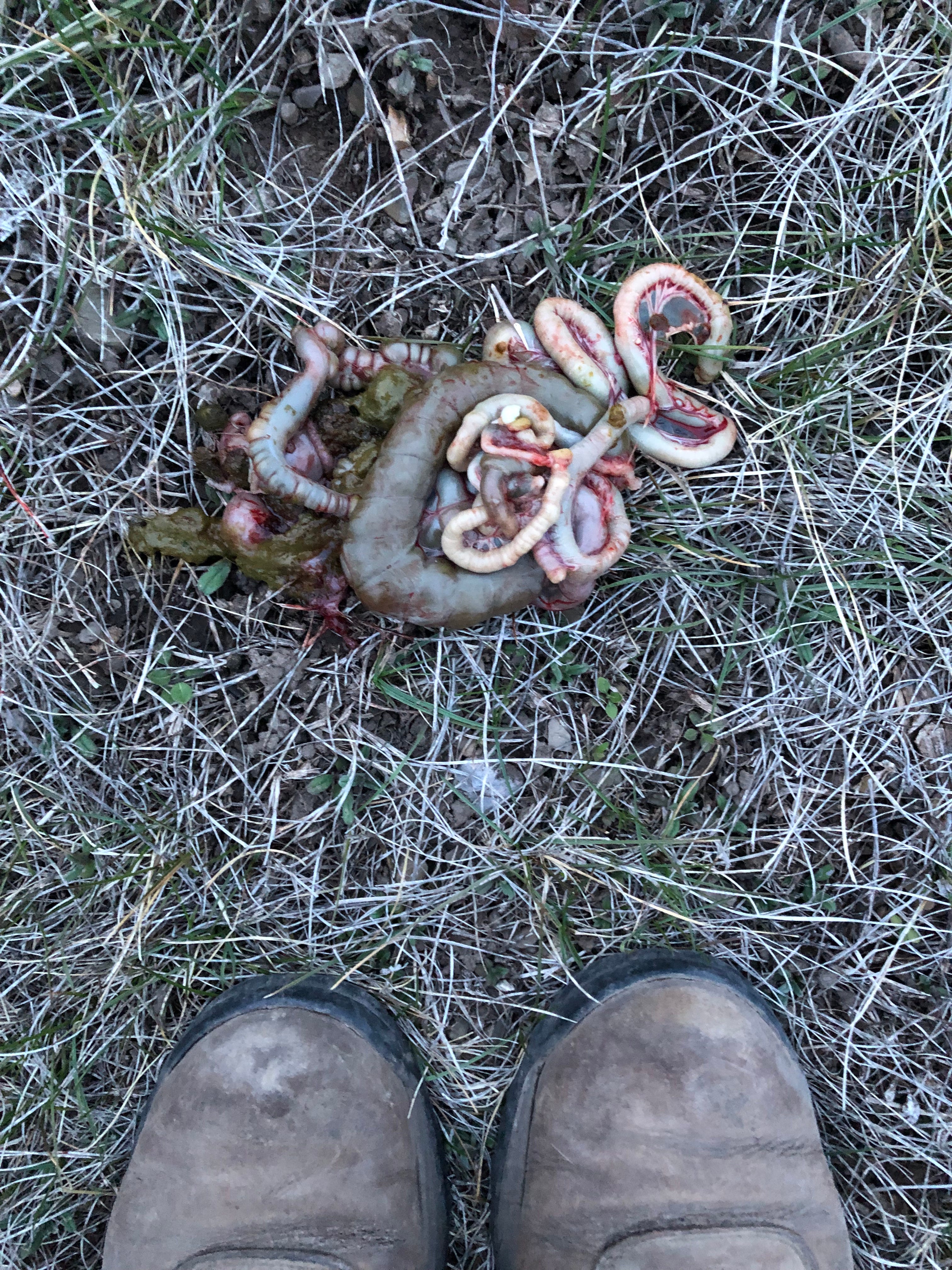
It’s the kind of group where you can show the photo of a really tidy pile of fresh entrails and ask, “do you think this is a rabbit? And what killed it and left such a clean gut pile?!” and not get a funny look. Instead, it’s met with curiosity and the comment, “oh, nice toes.” See, it’s helpful to have something for scale when identifying, and I often use my boots. I’d gone out the day after Daylight Savings…a whole entire morning hour—gone! The dawn was barely dawning and since cougars like hunting during those times, I tend to wait a wee bit longer. But I had to be at work sooner than later, and so the dogs had to get out earlier…as I walked, I made vocal (instead of internal) exclamations at the sweet spring birdsong and said hello to the newly germinated seedlings. Extra, alert and aware. I’d even taken the route closest to the road, on purpose.
Then, Pepper nudged my hand. I noticed. Soon after the energy shifted and the dogs SNIFF. We all spot it around the same time. A pile of what I thought was poo with tapeworms, was actually a pile of intestines and innards. Very, very fresh.
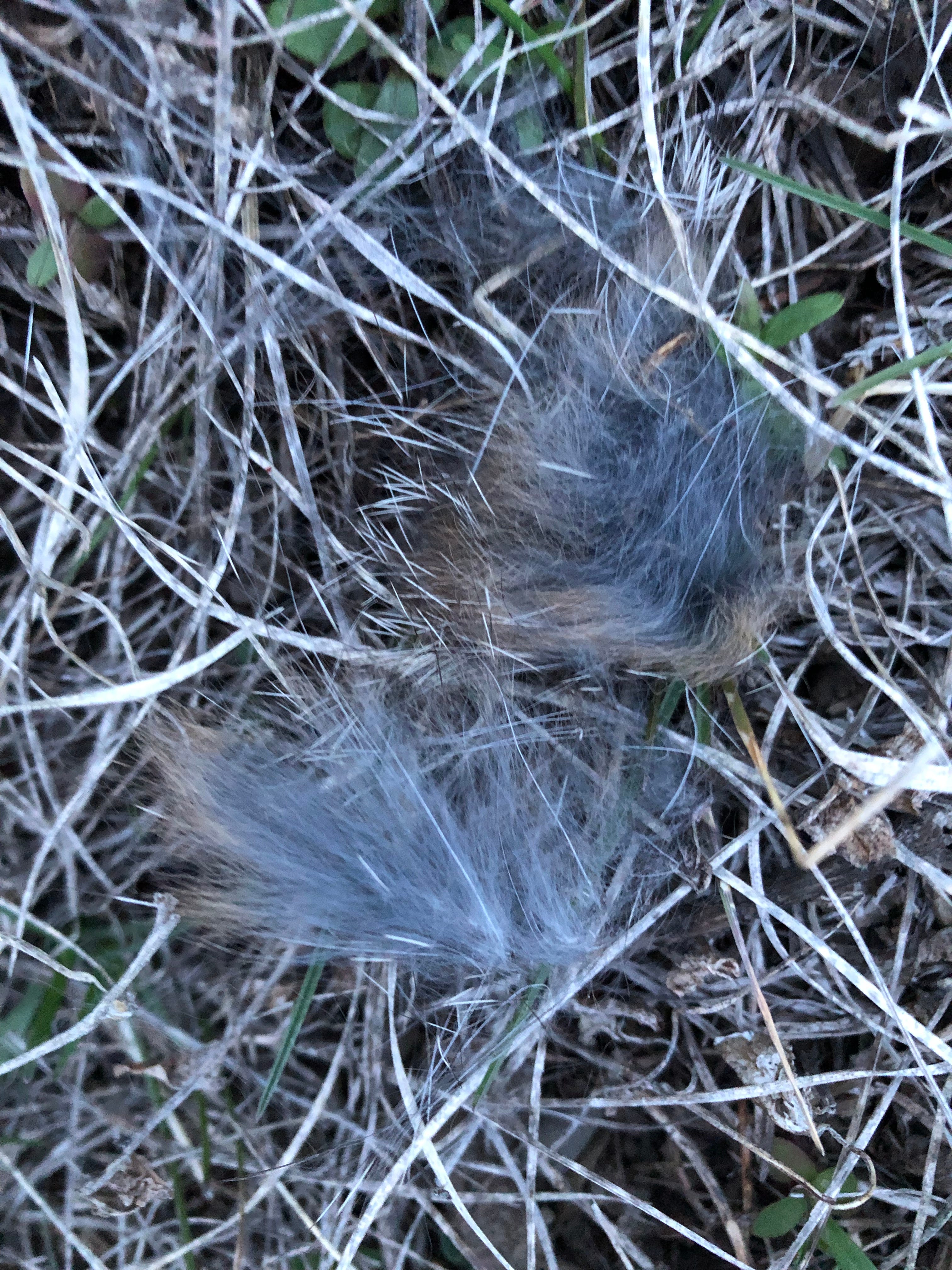
There are plenty of coyotes in these parts. Cougars here too—but they range wide, and for the most part, seem to wish to avoid people. My first feeling, however, was Cat. I’d felt it as soon as I got close. But it didn’t seem like a mountain lion. It seemed far too neat and tidy of a pile for an animal with such big paws…but…maybe!? In any case, a quick look around did not reveal the rest of the carcass. No blood, or tracks that I could easily see. On second glance I found wisps of super soft grey, black and white fur. But that was it. The dogs meanwhile were scenting strongly.
Decided to go forward, slowly. Made it about 10 steps and said screw it, I’m turning around. Different route. An intriguing, and somewhat exhilarating experience for 7:30 am.
It’s been nearly five years that I’ve lived here. Some parts of this land have become familiar. And slowly, but surely, I’m able to zoom out and get a better picture of what the surrounding region looks and ‘acts’ like. Listening to Shoshone-Bannock tribe members, Bailey Dann and Nolan Brown, describe their seasonal movements of their ancestors was neat to hear.
To observe this land from a bird’s eye view—the mountains, the river plains, valleys and steppes. The hot springs, the relics of volcanic eruptions, how the plant life shifts from alpine to high desert. How the roads flow in, up, down and out of the mountain passes, following the river-ways. Watching the migration of elk, moose and mule deer as they head higher up in elevation, following the sweet green grasses and tender tree shoots. Dann and Brown put up a flow chart of seasonal movement depending on what was available, south to the pinyon trees, into the mountains for moose, and in the springtime? Well, in the spring they traveled to Camas Prairie…
[The following comes from Dann and Brown’s presentation to our Idaho Master Naturalist’s class 2/5/26]
Yampadai (Camas Prairie) equates to wild carrot hole, a vital gathering and trading spot for the Shoshone-Bannock tribes. The area spoke about in this presentation is located in south central Idaho—and was a prime growing spot for Camas, a perennial wildflower whose bulb was utilized by the tribes as an excellent source of carbohydrates and protein. Many different tribes in the Mountain West to the southern end of the Pacific NW depended on this springtime native to supplement their long-term food storage.
Camas (Camassia quamash) is a slow growing plant that takes about 3-4 years to grow before achieving a good harvestable root size. Their bulbs are akin to onions and each ‘sheave’ within the bulb is a year’s worth of growth. It was cooked in underground earth ovens over a period of days. This caramelization creates a flavor that is likened to a sweet potato or molasses. They can then be eaten or further choped up and dried out. Often times these dried roots were crushed for flour or stored for later use. One could reconstitute in a soup.
In the areas where I normally venture, I’ve not ever seen camas growing wild. However, at a friend’s place, an hour and a half away, near the Wyoming border, camas blooms in their hay field. Not prolifically, but consistently. She took me out there during a visit one year in early June. They were just beginning to bloom and are a most striking flower. An absolute joy to behold. As I’ve been researching more about camas, it’s been said that many a man has been fooled by a field of flowering camas, thinking it a nearby shimmering lake.
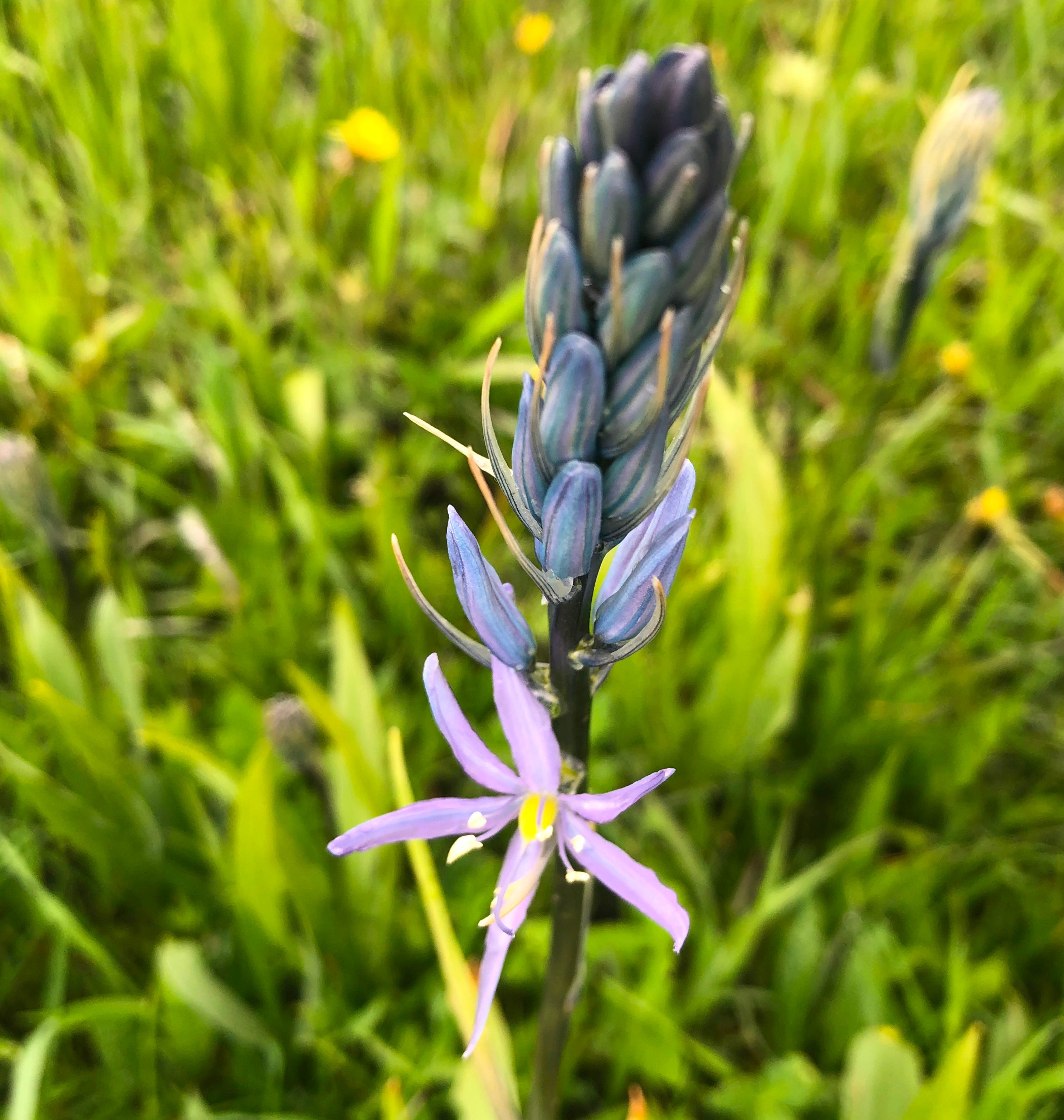
I did find some contradictory info about the ‘best’ time to harvest. Dann and Brown indicated that late spring (June) was their preferred harvest date, and some other sources (either native sourced websites or those from the National Park Service and the like), indicated that earlier in the spring was ideal or, in the later part of autumn. As a gardener and medicinal root harvester, this earlier to later time period makes sense. One doesn’t wish to gather dandelion root while that plant is in flower. If you’ve ever compared the roots of a blooming dandelion, to one not in flower, the comparison is stark. When flowering, the root is shriveled and a far cry from what it looks like (and contains medicinally) when not in bloom, since most of its energy is focused on seed production at that point. In the spring and fall, the energy is more potent in the root as the plant readies itself for a growing season, or it is storing energy, getting ready to put itself to bed for the winter.
But maybe camas is different? Maybe this bulb can be harvested ‘year round’? Maybe because it’s in the Lily family? I hope to learn that answer someday. Perhaps a part of this comes from the similarity of the camas root to the root of the death camas…and the need to keep them differentiated. While their flowers are dramatically different, it would be easy to confuse the two when not in bloom.
Now death camas, I’m familiar with. It is one of the first green shoots to arrive in the springtime where I walk my dogs. The death camas (Zigadenus sp.— Wikipedia now writes it as: Toxicoscordion venenosum) is one of the most poisonous western range plants. (Another is monkshood, aka aconite or wolfsbane). So how much death camas does it take to kill a human? Try typing that into your search bar without feeling a little odd!
Okay, wow. That was a rabbit hole. So, the nectar of the death camas is also rather deadly, so deadly that regular ole’ honey bees cannot tolerate it. There is a special kind of miner bee, known as the death camas miner bee, that pollinates it’s cream colored flowers in early spring.
And did you know that dried meadow death camas remains toxic for at least 20 years![i] I see where the next article is going to take us!
Okay, back to the topic at hand, camas…
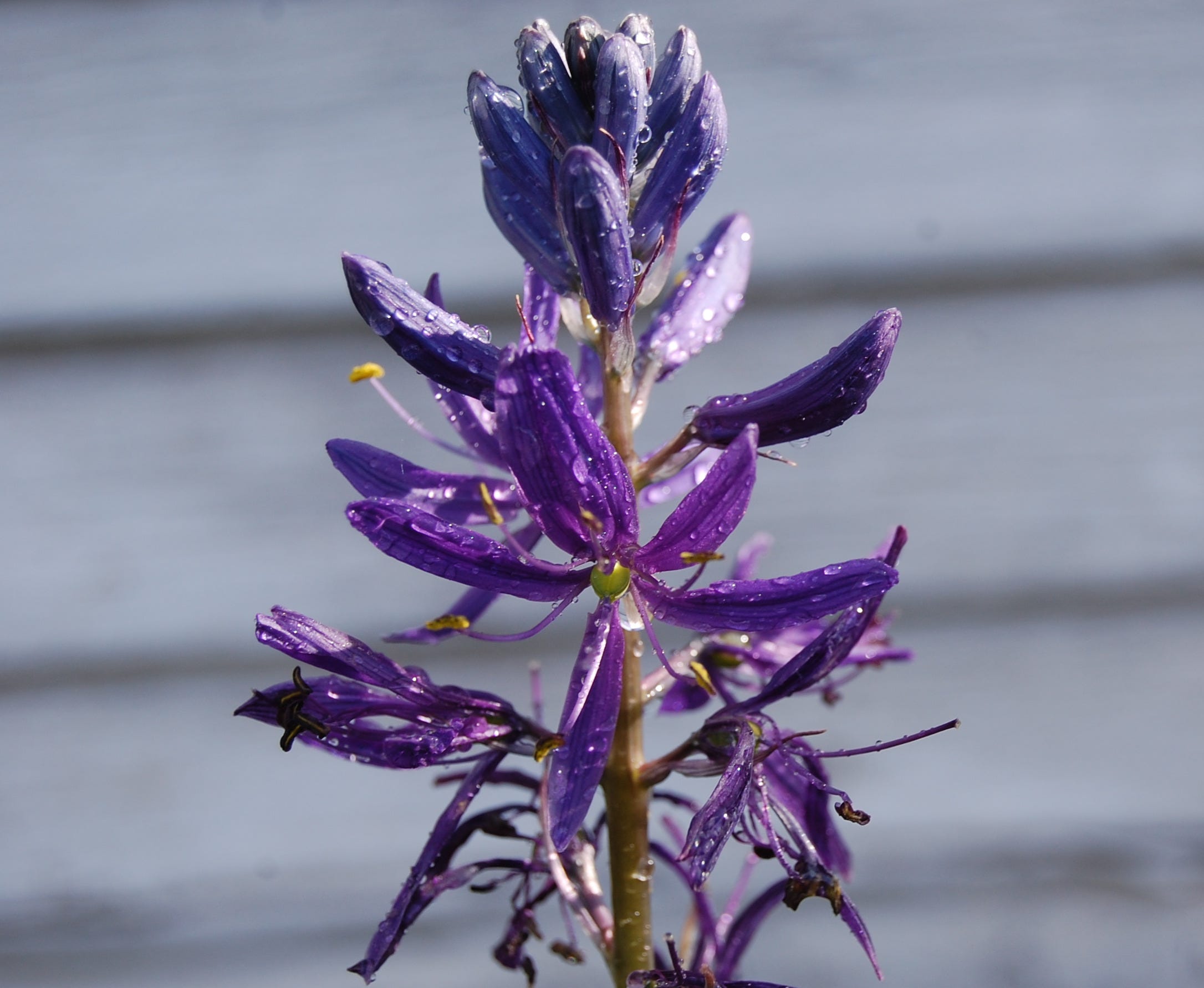
Since camas and death camas both share a similar time period of growth, in spring, it does make sense that some wariness is undertaken when harvesting in regions where both grow. I’ve not dug up both and compared the roots – do they look similar? Could be that without the flowers, they are nearly indistinguishable except to the trained eye or nose. Personally, I’ve witnessed camas in damper areas, while death camas tends to be in drier. But that could simply be my own experience and not widely applicable.
The following info comes from nativeamericannetroots.net:
“The proper time to gather camas is when the lower half of the flowers begins to fade. Indian people generally gathered camas in June, but this varied according to altitude and seasonal weather conditions. Some of the tribes, such as the Flathead, designated June as Camas Moon.
The camas was often dug up using digging sticks made from elk antlers. A woman could dig up about a bushel of roots in a day from a site that was about half an acre in size.
At the camas digging camps, the camas was usually cooked in earth ovens before eating it or storing it. Since the same camps were used each season, the pit ovens used for roasting the camas were also reused.
Although the men gathered the wood for the ovens, men were not allowed near the roasting pits for fear that the camas would not be roasted properly.
The oven (a roasting pit dug into the ground) was preheated by building a fire in it and placing small rocks (about 5″ in diameter) in with the wood. In addition to the small rocks, some pits had large flat stones on the bottom which were also heated by the fire. When the rocks were hot, they were covered with wet vegetation such as slough grass, alder branches, willow, and/or skunk cabbage leaves. Then the camas bulbs were placed on top of the vegetation. Sometimes Douglas onions (Allium douglasii) were placed in with the camas. The camas was then covered with bark and earth and a fire was built on top of the oven. Cooking usually took between 12 and 70 hours, depending on the number of camas bulbs in the oven.
The camas which was intended for storage was then dried for about a week. Dried camas can be preserved for many years. Some American explorers report eating camas that had been prepared 36 years earlier.
The early Europeans in the area, such as Lewis and Clark, occasionally consumed camas after they were shown how to harvest it and prepare it. One Jesuit missionary fermented camas to make alcohol. Another Jesuit missionary observed that the consumption of camas by those unaccustomed to it is “followed by strong odors accompanied by loud sounds”.
In order to increase the camas yield, the camas areas, as well as other root gathering areas, were occasionally burned over.” (https://nativeamericannetroots.net/diary/828)
That last bit made me giggle. Turns out when you don’t cook camas bulbs ‘correctly’ (like beans) they can give you gas!
Other portions of the Shoshone-Bannock presentation included a brief discussion of The Bannock War. This war took place in 1868. Settlers and non-native pioneers had settled in that rich meadow land region of Camas Prairie, and turned out their animals to graze. Hogs in particular, rooted up the camas and add sheep and cattle to the mix, and the cultivated Camas Prairie began to change. Prior, a treaty that was signed misspelled the word Camas for Kansas, which meant that the Shoshone-Bannock peoples didn’t have the ‘right’ to return to harvest there, so the settlers continued their use of that land without consideration of the people that had been there for generations before…By that point in time, these tribes were starving and entirely frustrated at having their ancestral harvesting grounds taken from them, and being stomped upon by livestock. The Shoshone-Bannock tribes, along with the Paiute of Oregon, rebelled against the settlers and gave it a good fight, but in the end, were too few and under-nourished to reclaim their un-ceded lands.
Nowadays, the Shoshone-Bannock still return to their ancestral camas lands, but it’s not just for digging up the roots for food. There is another foe to defend against…woho-sonipe. Enemy grass.
The enemy grass, aka Garrisons creeping meadow foxtail (Alopecurus arundinaceus), originally came from Siberia. First found in North Dakota, it was probably brought over with immigrants. Later, the NRCS (Natural Resources Conservation Service) started to grow it and sell seed – it reproduces exceptionally well, to the detriment of native grasses and plants. It is currently invading the Camas Prairie. Badly. If any of you all garden, you know how tenacious crab grass is to get out of a chive patch. Now, imagine that on a much grander scale. More information on how to identify Garrisons is here.
This influx of non-native, invasive grass on an incredible, and beautiful, natural resource is disheartening. Especially since the camas of Camas Prairie is known to be some of the best and biggest bulbs in the region! There are other ‘fields’ but none produce like Camas Prairie. Both Dann and Brown made it clear that their tribe wants to keep the genetics of these larger bulbs from being muddled with less desirable camas bulbs/seeds. So please, only reseed or plant camas from the SAME area back into that area. (You can grow camas from seed, it is a very slow process. You can also replant smaller bulbs after harvesting larger bulbs.).
Of note, if you live near a prolific camas area, please follow these ethical and sustainable wild crafting guidelines.
Because camas equals food, the tribe is clear that they do not want to use chemical herbicides to attempt to reduce the Garrisons grass. I think this is hugely important and I was heartened to hear this message: “staying organic, because we’re Bannock.” These tribe members also recognize that they need help dealing with this tenacious grass. They are working in conjunction with the Idaho Fish & Game to tackle this issue. In our naturalists’ class, those of us interested signed up to receive more info via email when Garrisons grass weeding parties would take place. For those local, I can share that info when it comes.
Other ways to help? Educate yourself on what Garrisons looks like and whether or not you may have some on your lands that could be pulled out to slow down its spread. Grow camas in your garden! It’s a lovely flower and comes up after the flamboyant flush of tulips, and before many of the summer blooms. When you’re walking into pristine landscapes, be sure to have cleaned your hiking boots prior. Lots of non-native seeds can hitch a ride in the dried mud smooshed in those treads…
Speaking of hikes, I suppose I should share what the retired Fish & Game habitat manager thought of that gut pile. Well, she confirmed my initial thought of the pile formally belonging to a rabbit. The fur picture was a dead giveaway—glad I spotted that, it was a windy morning. She also confirmed my ‘cat’ feelings…but surprised me when she said that it was most likely a bobcat! Wow, a bobcat! Apparently, they like to keep things neat and tidy. She said there were many in that area (truly, she would know). When I mentioned that I was near a road, she said that she’s mostly seen bobcats via roadside, more than anywhere else.
Here is the photo of those entrails. I saved it for last so you weren’t surprised or disgusted. If you want to see, just scroll down a little bit. It’s not gory, just kinda gross. And if you don’t want to see that, here’s your warning. But maybe you’re like me and curious about what’s what, and if you’re out walking around in the woods and you find a really fresh pile of guts that seems oddly out of place because it’s so tidy…well, maybe be on the lookout for a bobcat!
And before I forget, because I did forget to mention it in that last letter, I have turned on subscriptions again. I am deeply grateful for your support, thank you so much!
Pic…
.
.
.
.
.
.
.
[i] Smith, R. A.; Lewis, D. 1991. Death camas poisoning in cattle. Veterinary and Human Toxicology. 33(6): 615-616. [62949]
Fascinating read! I very much enjoyed it. Is there a reason why bobcats don’t eat the intestines with everything else? Is this normal for big cats?