
Tincture Time
+ a couple of seasonal Bitters recipes

Happy November folks :)
(Hope you enjoy this little tincture missive written + photos taken, only by yours truly!)
It has been unseasonably warm in these parts. The reseeded Violas are blooming, standing strong. It has snowed, but melted off the high up pathways I take. Most of the leaves are off the trees. On today’s dog walk, the mountain forest glowed a sweet amber as the sun rose. There is a decided quiet amongst the trees now. It’s lovely.
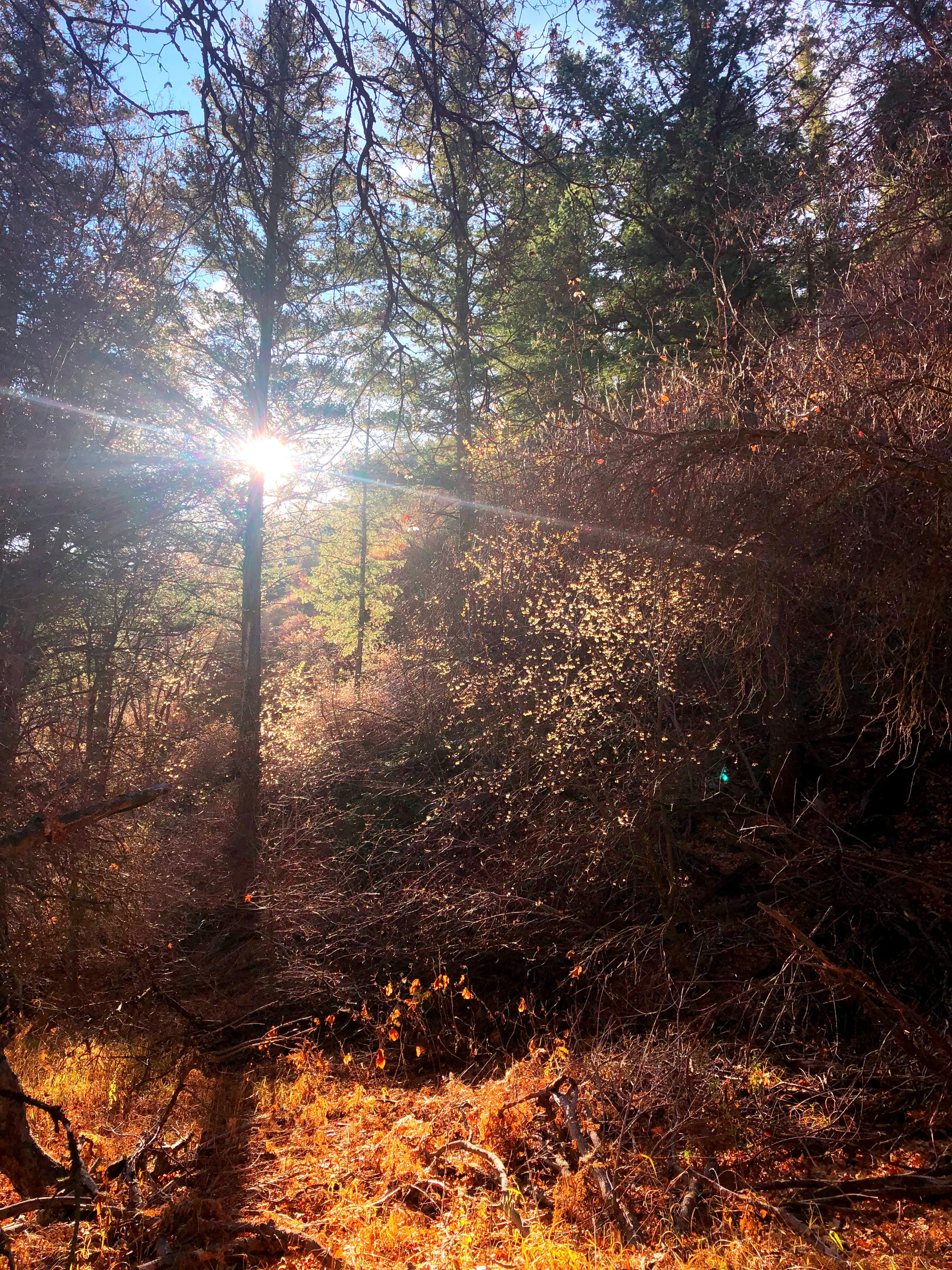
Last week on this pathway, I came upon a large grey predator bird having a spruce grouse lunch. The feathers are still there, the body, not. I didn’t get a good enough glance at the big raptor at hand, but the way it flew so effortlessly through those trees…wow. Stumbling onto things normally not seen.
Just thought I’d write a hello, how are you, this is what I’m up to letter. It’ll be mostly about plants, because, well, I love them. And I love what you can make with their help. Thought I’d focus on tinctures today as I strained out some good ones at the tail-end of October and used them quite heavily when I sensed a cold coming on shortly thereafter.
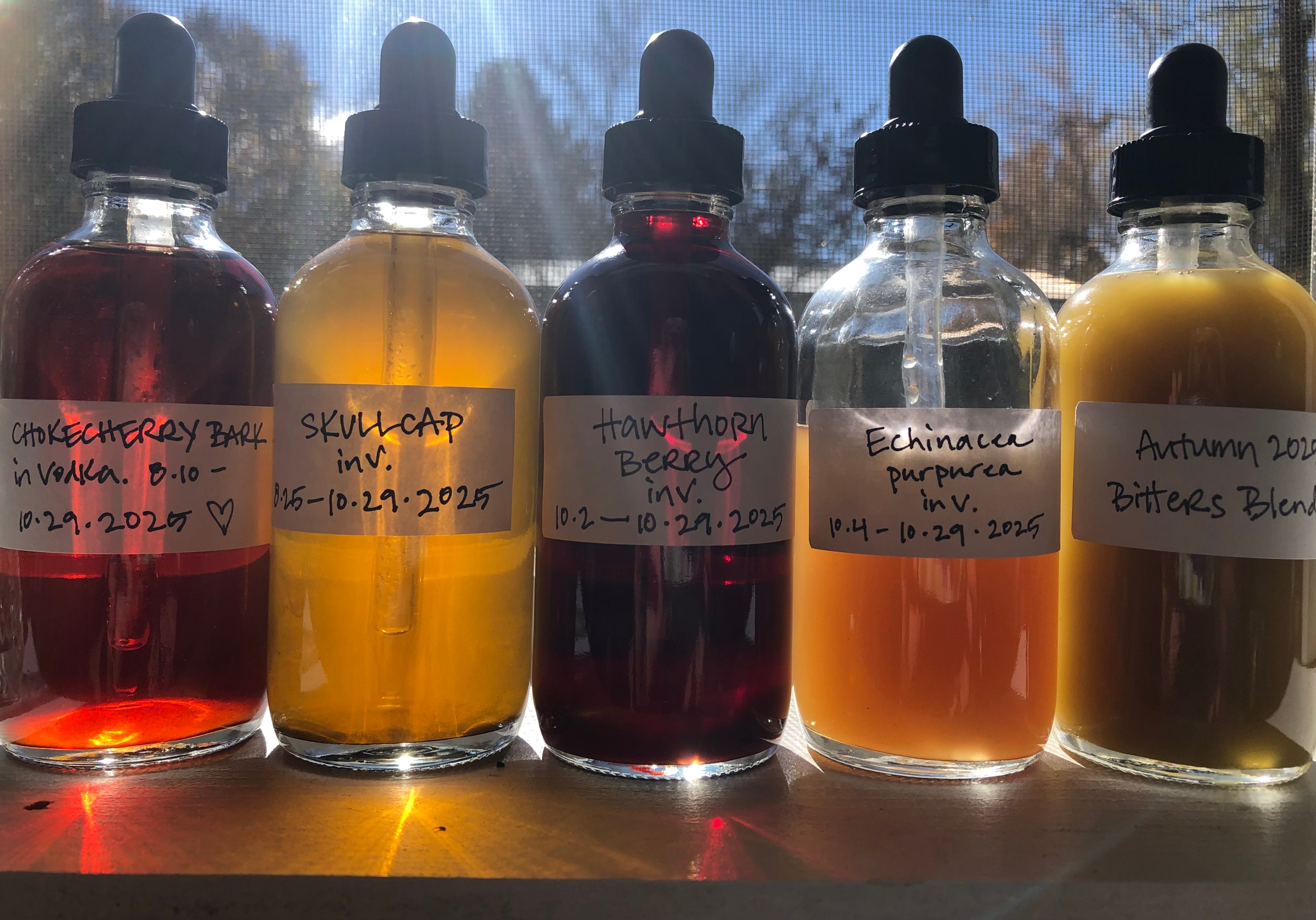
These tinctures were all made using an organic vodka (40% so 80 proof). That is what I have relatively easy access to, and works well for my uses. Often in herbal preparation books they call for a higher proof (50-95%) in order to pull out more of the good stuff, but if a little lower is all you can find to work with, it’ll do the trick for the home herbalist.
Also of note, please be sure to do your due diligence with further readings if you choose to gather wild plants, and/or ingest herbs—make sure you double check, especially if pregnant or nursing, or taking any medications, if a plant is right for you. The following isn’t medical advice in any way, shape or form.
I like having the Chokecherry bark tincture on hand for colds with coughs. It’s not a remedy I’ve used for long—I only landed in its midst four years ago, but the Chokecherry tree is becoming a favorite of mine. The berries make a divine syrup and I thought that adding the tincture of the bark to the syrup would give it added cough relieving capabilities. Alcohol also helps with preservation, and extending the life of a syrup is handy.
As for the Skullcap, this is a lower dose botanical tincture. Think 5-30 drops at a time, a few times per day. I love this tincture for its ability to work FAST. When you’re all tied up in knots, filled with overwhelm and just not sure where to go, yet there’s all this nervous, physical energy buzzing about…try Skullcap tincture. After you take it, just stand still, and breathe. Within a few minutes, you may notice your shoulders visibly lowering and relaxing. Maybe the knotted stomach softens. This is a wonderful, and effective nervine. That means it helps calm your nervous system, it unwinds the nerves. It tastes awful though, and makes a terrible tea. A glycerite might be nice, especially for hyperactive kiddos. A few drops in a Chamomile tea might be a comforting new bedtime ritual.
Hawthorn has become one of my treasured trees. They are an abundant source of medicine and grow all over this region. You might have them near you too, they are wildly adaptive and there are many species that perform similarly. (If you wish to dive deeper, Haven Making II: The Wild Ones – Hawthorn, is available to read for paid subscribers.)
This was one of the tinctures that I used a bunch when I felt the throat tingle, that little cough, some congestion…give me those antioxidants! Help me heart beat better! (Sorry, that last bit was wrote in a Irish accent, I’ve been reading a book where one of the characters is Irish!) To me, this tincture is nourishing and I just felt aided by the energy of this tree. It was fresh, incredibly potent and it tasted really good. Hawthorn is a tree I visit often while walking my pups. I’ve really come to respect, enjoy and revere this plant.
Next up is Echinacea. You’d think that as an herbalist, lover of plant medicine and magic, that Echinacea was always a top ten herb pick for me. Well, it wasn’t—I tried making a tincture from dried, organic roots when I lived in Alaska. When we moved, I dumped the whole thing out—it just felt, flat, not helpful. Now…well, I gotta say, I really like using this plant for medicine! She’s been growing in my garden ever since 2022 when I received the wrong live plant order from Azure Standard.
Four Echinacea purpurea, arrived and four Echinacea plants went into the garden. I’m so grateful for that wrong order! Absolutely stunning bloomers, and very hardy. They were also certified organic plants, so it made choosing to use them for medicine much easier. I haven’t worked with the blooms aside from beauty as medicine, and the bees LOVE this flower—it’s an excellent addition to the perennial patch or interspersed with Calendula and Yarrow for an eye-catching, 80’s inspired combo.
Unlike Elecampane, which grows its roots really fast, Echinacea takes time to grow and you want to harvest roots that have been growing for about 4 years. If the plant is in an optimal place, three years might do it. I think older plants are fine to harvest, but I haven’t worked with them yet, so a bit uncertain—some roots get woody with age.
There really is something special that occurs between a person and a plant when the person KNOWS the plant personally—gosh, say that ten times fast! I practice what is known as Bio-regional herbalism. That is, I mostly utilize the plants that grow wild around me, and whom I ‘know’, or ones that I grow in my garden. That’s not to say that I don’t order any out, but it’s not much. I like knowing where my plant medicine comes from. To me that is one of the principle healing factors within—having that relationship.
If I could do one thing over in this garden of mine, I’d put all the perennial medicinals and Strawberries and Asparagus in the center of the garden. Then, all around them, the annuals. That way, I can keep the grass out easier, ‘simply’ digging out the edges and pulling out any grass roots at the beginning/end of the gardening season—once grass moves into your perennials, it’s a b*tch to get out. It’s one of the reasons I decided to dig up an Echinacea plant this year, I have to renovate the bed it’s in and wanted to get a head start on it.
E. angustifolia (the wild native) is known to be more difficult to grow than the cultivated E. purpurea. I haven’t used, nor attempted to grow E. angustifolia, so can’t speak to that. Oftentimes their uses are combined into Echinacea spp., and there are slight differences worth noting.
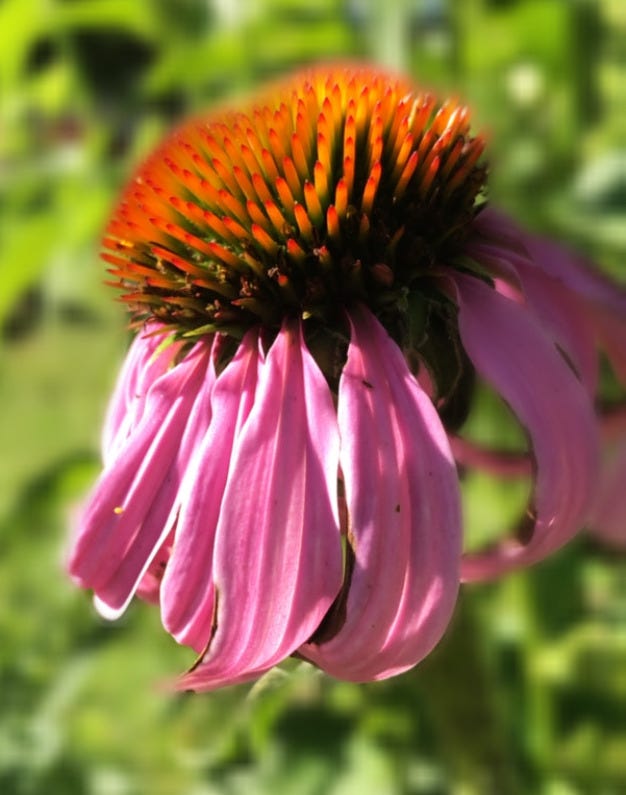
I’d say, if you have a garden, try growing E. purpurea—but I would source organic, or heirloom, non-GMO seeds/plants if you’re growing them for medicine. If you live where E. angustifolia grows rampant, follow these harvest tips —>
E. purpurea can help tonify the blood and reduce inflammation by enhancing liver function. It’s a blood tonic that helps modulate the immune response. It can also aid in strengthening and clearing the lymph nodes. I did utilize this tincture right away when I felt the symptoms that all was not quite right. However, this isn’t the best herb to use when you’re in the thick of snot. Use it early, I did about 2 dropperfuls 2-3X/day for four-ish days. You can tell the potency of this herb if it tingles a little, sort of like Spilanthese, but not as intense. Proudly, mine did this.
Like many of my root harvests, I try to regrow (usually successfully) the root base. I split up and replanted the harvested Echinacea into a large planter pot for overwintering, added a bunch of leaves to insulate. I’ll report back next Spring and let you know if it worked out!
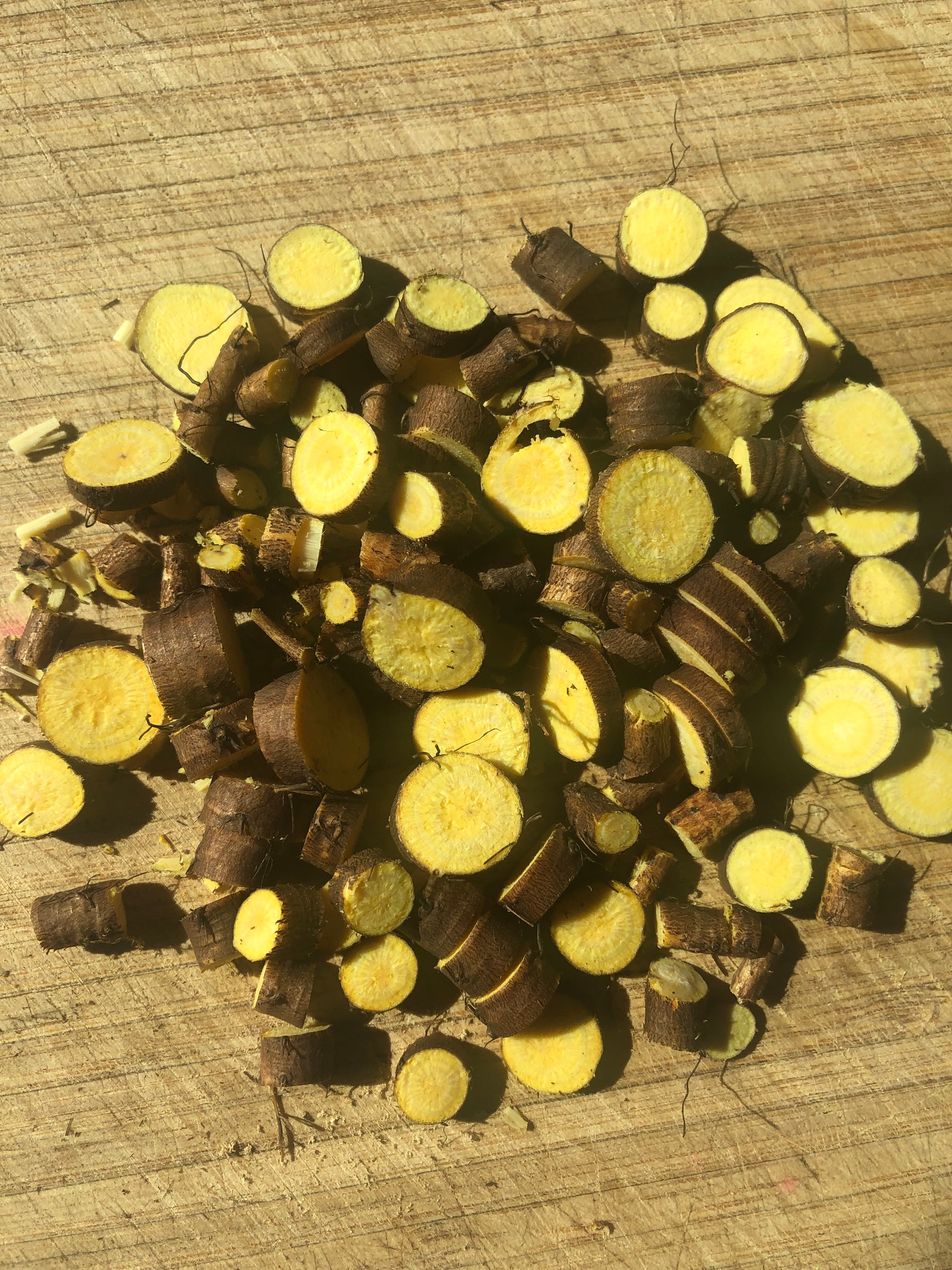
Lastly, we come to the Bitters Blend. This one was fun to make. It literally came into being as I was weeding the garden in early October. I had some Dandelions I wanted out—yes, I have to weed them AND I let some stay for later use. Also, there were a couple of Yellow Docks that I allowed to grow, but now was the time to pull them out. The Yellow Dock was gorgeous and I knew then and there that I wanted to use it right away.
I decided to make a seasonal bitters blend to aid with digestion. My tummy hasn’t been the same since having my appendix removed, and I’m on a healing quest in that regard. Taking bitters 20 minutes or so before meals can get the stomach juices activated, getting the body ready to intake food and utilize the nutrients contained therein. Dandelion root is another awesome bitter that has a multitude of other benefits, so that was going in there as well.
I hosed off and then scrubbed the Yellow Dock and Dandelion roots. Brought them inside and began chopping them up. Decided to add the following fresh ingredients: Ginger and some Orange peel, I had a Blood Orange that did the trick. These really help with flavor and Ginger is a potentizing plant—it has the ability to accentuate the power of the other herbs in a formula.
The dried plants that I decided to add were: Rose hips, Oregon Grape Root (another bitter), and Elecampane root.
Like all grand recipes…I didn’t write down any amounts. This is totally a working recipe. Just some ideas that can be played with. I might have added some Yarrow leaf/flower, another bitter—but that is pretty strong flavored, FYI. Effective as all get out, but strong. So, I didn’t add it this round.
I was going for something that tasted good.
Autumn Bitters Blend
Here are approximate amounts:
Yellow Dock, fresh root: about 1/3 cup
Dandelion, fresh root: about 1/3 cup
Ginger, fresh root: a good thumb sized chunk, peeled
Blood Orange peel: one
Rose hips, dried: small handful
Oregon Grape Root, dried: about 1 T.
Elecampane root, dried: about 1/3 cup
Pine needles: small handful
Instructions:
I chopped up (if needed) and placed all the herbs into a pint jar EXCEPT for the Pine needles, wait for those. A sprinkle of this, a dash of that. Added vodka to cover. And steeped for one month. Then I strained that mixture.
To the strained mixture I added a small handful of fresh Pine needles. This I blended up until the needles were chopped smaller and dispersed through the blend. Next, I steeped that mixture for two more days. Then strained for the final product.
Note that this blend will separate out and a layer of white inulin will form on the bottom of the bottle. This is normal, (inulin is a prebiotic starch that helps feed your good gut bacteria) and is remedied by shaking up the tincture before use. Both Dandelion and Elecampane roots contain a lot of inulin, especially from fall harvests.
The final product was mellow flavored (to me), rather delicious, and certainly helpful. I’ve been adding it to my daily routine (slowly, sometimes I forget and take it after eating), and I am very happy that I made it. This is kitchen magic, wild-harvested, garden medicine. A potion that you can make and use to help yourself, your family, friends and maybe beyond.
For those of you that prefer an actual recipe, I decided to include a divine blend I created a few years back. It was in ✦ Haven Making: December ✦, so if you have that available, you can find it there amongst the Fir, Pine, Hemlock & Spruce section.
If you liked what you read, please leave a comment and tap the heart button :)
The following recipe is available to paid subscribers as a thank you for their support and contribution to these writings. I appreciate you so, so very much!!
Having a Thanksgiving Sale on Substack subscriptions this year ~ I’m offering year-long access for $60 instead of the current $80—running November 22nd—December 2nd, 2025. You’ll have the key to all locked posts for the year, as well as Haven Making II articles, past, present and future. If you know someone who loves plants and would enjoy reading these missives, consider gifting a subscription for Christmas!